They eat smaller portions

Overeating is less of a problem in Japanese culture due to
the nature of their workday. Having to rise early to commute to work and
return late means meals on the run and in smaller portions. According
to Theodore Takata,
MD, a clinical cardiac electrophysiologist at Texas Health Fort Worth,
"The Japanese have portion control ingrained in their culture. Following
a particularly good meal, the Japanese use the phrase 'Hara Hachi Bu.'
This phrase simply means 80 percent, as in 80 percent full. At 100
percent, a person is said to feel uncomfortable and stuffed."
They eat fermented foods
 No Korean meal is complete without a side dish (or two) of kimchi. The
fermented food craze has been widely praised by nutrition experts:
According to Ornish Lifestyle Medicine,
"Fermented foods reduce inflammation, improve immunity, digestion and
gut health, support weight loss by enhancing metabolism, improve mental
health, and even reduce the risk of heart disease." Make sure you avoid
these 13 foods cardiologists never eat.
No Korean meal is complete without a side dish (or two) of kimchi. The
fermented food craze has been widely praised by nutrition experts:
According to Ornish Lifestyle Medicine,
"Fermented foods reduce inflammation, improve immunity, digestion and
gut health, support weight loss by enhancing metabolism, improve mental
health, and even reduce the risk of heart disease." Make sure you avoid
these 13 foods cardiologists never eat.They choose green tea over coffee

Green tea is loaded with antioxidants, which can lower
blood pressure and cholesterol. And while most Americans reach for the
coffee machine on instinct, Japanese people opt for tea bags. Claire
Koga, MD, a family physician and board member of Keiro,
a non-profit health group, points out: "Japanese consume large amounts
of tea, particularly green tea. Several studies have shown that
antioxidants, specifically flavonoids found in green and black teas, may
protect the heart in part by improving endothelial function—and this
can reduce the risk of clogged arteries."
They eat a lot of fish
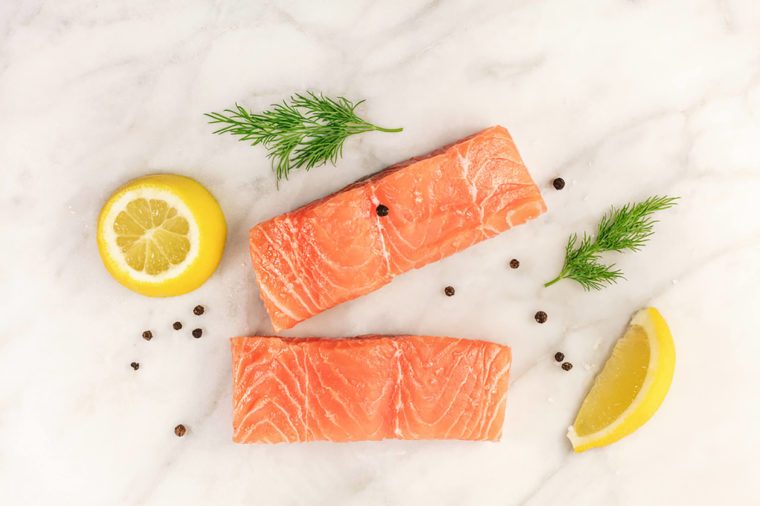
It's no secret that fish is insanely good for you. But
integrating them into your daily diet the way the Japanese and Koreans
do helps boost lifespan. The secret lies not in fish's protein and
vitamin D (added bonuses), but the omega-3 fatty acids. "The number one
explanation [of great heart health] is the greater consumption of fatty
fish rich in omega-3 fatty acids such as EPA and DHA. This can be
measured by the AA/EPA ratio in the blood, which is seven times lower
than Americans," says Barry Sears, MD, author of the Zone Diet book series and president of the Inflammation Research Foundation.
Content continues below ad
They don't spend too much time sitting down
 TV is much less present in both French and Japanese culture, which
contributes significantly to their low death rate. The stats back this
up: In a Canadian Fitness survey, those who stood most of the day had a
33 percent lower mortality than those who sat. According to Dr. Takata,
"Using hours of television watched per week as a surrogate for
sitting—people can remember how much television watched in a week more
easily than how much time they sat—one study
demonstrated that every single hour of television watched after the age
of 25 years reduces the viewer's life expectancy by 21.8 minutes."
TV is much less present in both French and Japanese culture, which
contributes significantly to their low death rate. The stats back this
up: In a Canadian Fitness survey, those who stood most of the day had a
33 percent lower mortality than those who sat. According to Dr. Takata,
"Using hours of television watched per week as a surrogate for
sitting—people can remember how much television watched in a week more
easily than how much time they sat—one study
demonstrated that every single hour of television watched after the age
of 25 years reduces the viewer's life expectancy by 21.8 minutes."They drink alcohol moderately

People who want to live longer may want to avoid bars. In his book, The Blue Zones Solution,
Dan Buettner shares the healthy habits of several enclaves of
long-lived populations. Most notably, these people drink alcohol
moderately but regularly. He writes, "Moderate drinkers outlive
non-drinkers. The trick is to drink one to two glasses per day... with
friends and/or with food. And no, you can't save up all weekend and have
14 drinks on Saturday."
They choose red wine

Take a stroll down Champs-Élysées, and you'll easily be able to spot Parisians at a café sipping wine—almost any time of day. Yet, the French population is much healthier in comparison to other health-obsessed nations riddled with heart disease. This strange phenomenon, dubbed the French Paradox, has baffled researchers for a long time. The exact reason for the country's low rate of heart troubles is unclear, but researchers believe that their red wine intake contributes significantly to a heart-smart diet. Pair your glass of vino with the best foods to eat to avoid clogged arteries.
They walk everywhere
 The world's longest-lived people aren't focused on pumping iron,
running marathons, or joining gyms. Instead, they live in environments
that encourage and support activity. In France, Japan, and Korea,
driving (especially in major cities) is less common. Instead, people
frequently walk, bike, or take public transportation. "Moving naturally
refers to remaining active during the course of daily activities," notes
Dr. Takata. "Unlike in the States, most travels in these countries
require walking several blocks to the train station, transfers at large
train stations, and more walking once the destination is reached."
The world's longest-lived people aren't focused on pumping iron,
running marathons, or joining gyms. Instead, they live in environments
that encourage and support activity. In France, Japan, and Korea,
driving (especially in major cities) is less common. Instead, people
frequently walk, bike, or take public transportation. "Moving naturally
refers to remaining active during the course of daily activities," notes
Dr. Takata. "Unlike in the States, most travels in these countries
require walking several blocks to the train station, transfers at large
train stations, and more walking once the destination is reached."
Content continues below ad
They eat less red meat

Bacon and hamburgers are American, period. But cutting red
and cured meat from your diet just may lower your risk of heart disease.
According to Dr. Koga, Japanese people tend to eat less meat than
people in Western nations. They tend to get their proteins from lean
meats, which contributes to a lower cholesterol and a decreased risk of
coronary heart disease. (Check out what else happens to your body when you stop eating red meat.)
They keep an eye on their weight

According to OCED
data, South Korea and Japan have the lowest obesity rates in the world
(with only about 4 percent of the adult population being obese). As the American Heart Association
points out, overweight people are 32 percent more likely to develop
cardiovascular disease in their lifetime compared to people at normal
weight. If you want to take a cue from these winning cultures, take the
time to savor your meal. Studies have indicated that eating fast may
lead to eating more, which in turn leads to greater obesity rates.
They take time to relieve stress
 Zen is an important concept in both Korean and Japanese philosophy,
which encourages stress reduction through meditation. According to
Buettner, "Stress leads to chronic inflammation, [which is] associated
with every major age-related disease. What the world's longest-lived
people have that we don't are routines to shed that stress. Okinawans
take a few moments each day to remember their ancestors, Adventists
pray, Ikarians take a nap, and Sardinians do happy hour."
Zen is an important concept in both Korean and Japanese philosophy,
which encourages stress reduction through meditation. According to
Buettner, "Stress leads to chronic inflammation, [which is] associated
with every major age-related disease. What the world's longest-lived
people have that we don't are routines to shed that stress. Okinawans
take a few moments each day to remember their ancestors, Adventists
pray, Ikarians take a nap, and Sardinians do happy hour."They smoke less

We all have different lifestyles, but a bad heart may be a
sign that you're smoking too much. Many people point to Japan's steadily
declining rate of smoking as an explanation for their rising life
expectancy. According to Dr. Koga, "Smoking rates, especially among men,
have declined substantially in Japan since the 1960s when the vast
majority of men smoked. When one quits smoking, that person's risk of
heart disease decreases greatly compared to that of a smoker."
Content continues below ad
They have lots of preventive care

Doctor visits are still key to preventing future heart
problems, Dr. Koga says. "Preventive care is frequently practiced in
Japan, and Japanese health care providers are more likely to catch
problems early on when they can be more easily treated and/or managed.
Annual comprehensive physical exams are quite common as well. The
government and employers often encourage their employees to adopt
healthier behaviors based on the results of these annual exams." (Check
out the heart health tips that cardiologists always follow.)
They maintain tight social networks
 Want
to lengthen your lifespan? This one may be the easiest of them all:
Keep your friends. Buettner notes, "The world's longest-lived people
chose—or were born into—social circles that supported healthy behaviors.
Okinawans created 'moais'–groups of five friends that committed to each
other for life. Research from the Framingham Studies shows that
smoking, obesity, happiness, and even loneliness are contagious. So the
social networks of long-lived people have favorably shaped their health
behaviors." Don't forget to check out these 30 ways to reduce your risk of heart disease.
Want
to lengthen your lifespan? This one may be the easiest of them all:
Keep your friends. Buettner notes, "The world's longest-lived people
chose—or were born into—social circles that supported healthy behaviors.
Okinawans created 'moais'–groups of five friends that committed to each
other for life. Research from the Framingham Studies shows that
smoking, obesity, happiness, and even loneliness are contagious. So the
social networks of long-lived people have favorably shaped their health
behaviors." Don't forget to check out these 30 ways to reduce your risk of heart disease.
Comments
Post a Comment